Why Do We Square the Differences When Calculating Variance?
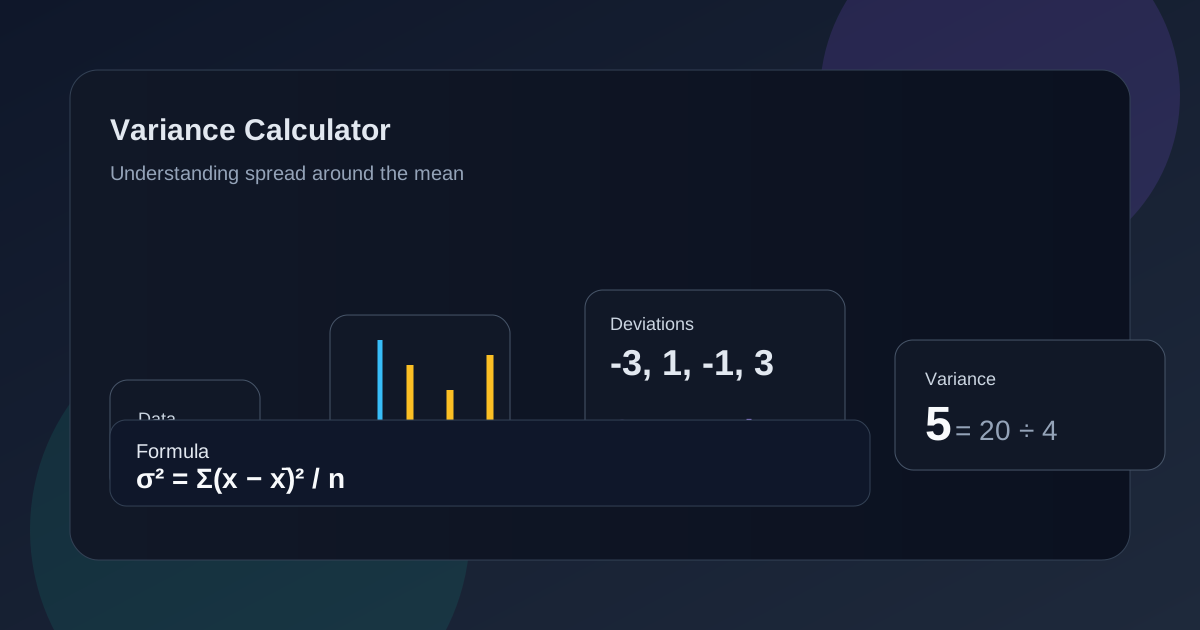
Ask why variance squares its deviations, and most people shrug, assuming it’s just an arbitrary mathematical rule to memorize. It isn’t. Squaring solves a genuine, specific problem that would otherwise make variance completely useless as a measure. Understanding why we square the differences transforms this step from a memorized formula quirk into a piece of mathematical logic that actually makes sense once you see the problem it solves.
What Happens If You Add Positive and Negative Deviations Directly?
Summing raw deviations from mean without squaring always produces exactly zero, since positive and negative differences mathematically cancel each other out completely, regardless of actual spread.
This cancellation happens by definition, since the mean sits at the exact center of balance for any dataset, making raw deviation summation useless for measuring spread.
How Does Squaring Make Every Deviation Positive?
Squaring any number, whether originally positive or negative, always produces a positive result, since multiplying two negative numbers together yields a positive product.
This universal positivity ensures every observation contributes meaningfully to the final sum, rather than canceling out a comparably distant value on the opposite side of the mean.
Why Do Larger Deviations Receive More Weight After Squaring?
Squaring doesn’t treat all deviations equally; a deviation twice as large becomes four times as large once squared, disproportionately weighting bigger differences in the final variance calculation.
This weighting means variance naturally emphasizes larger deviations more heavily than smaller ones, making it particularly sensitive to values sitting far from the mean.
How Does Squaring Prevent Positive and Negative Differences From Canceling?
By eliminating negative signs entirely, squaring ensures that a value sitting three units below the mean contributes identically to one sitting three units above it, rather than offsetting each other.
This deviation cancellation problem, present in raw differences, disappears completely once every value gets squared before being summed together.
What Would Variance Look Like Without Squared Deviations?
Without squaring, you’d need an alternative approach, like taking absolute values instead, which mathematicians do use for a related but distinct measure called mean absolute deviation.
| Approach | Result |
|---|---|
| Raw deviations | Always sums to zero |
| Squared deviations | Produces meaningful variance |
| Absolute deviations | Produces different measure entirely |
How Does Squaring Connect Variance to Standard Deviation?
The squared deviations used throughout variance calculation directly explain why standard deviation requires taking a square root afterward, reversing that squaring to return to original units.
This relationship shows squaring isn’t an isolated step; it’s fundamentally connected to how these two related measures of spread work together mathematically.
Why Does Squaring Change the Units of the Final Variance?
Since squaring multiplies a unit by itself, dollars become dollars-squared, and inches become inches-squared, producing the somewhat unusual squared units characteristic of raw variance values.
This unit transformation, while mathematically necessary, is exactly why standard deviation often gets reported instead when intuitive, original-unit interpretation matters more than mathematical convenience.
How Can a Simple Numerical Example Show the Purpose of Squaring?
Consider deviations of -4 and +4 from a mean. Summed directly, they cancel to zero, but squared, they become 16 and 16, summing to a meaningful 32.
This simple squared difference example demonstrates concretely how squaring rescues an otherwise completely uninformative calculation from producing a meaningless zero result.
Does Squaring Make Variance More Sensitive to Outliers?
Yes, this outlier sensitivity is a direct consequence of squaring, since one extremely distant value produces a disproportionately massive squared contribution compared to typical, closer observations.
This heightened sensitivity is both a feature and a limitation, explaining why variance requires careful outlier consideration before trusting it as representative of overall data spread.
How Does This Step Fit Into the Complete Variance Formula?
Squaring sits precisely between calculating individual deviations and averaging them together, forming the crucial middle step that transforms meaningless raw differences into a genuinely useful variance formula.
Removing or replacing this squaring step would fundamentally break the entire calculation, which is exactly why it remains a non-negotiable part of how variance gets computed.
Conclusion
Squaring deviations solves the specific mathematical problem of positive and negative differences canceling each other out completely. This single step transforms variance from a meaningless zero into a genuinely informative measure of spread, while simultaneously explaining its heightened sensitivity to outliers and its connection to standard deviation.